3 1/2 Inch Round Head Nail Gun Reviews
Full-Size Pneumatic Framing Nailers
Caput-to-Head Testing
Pneumatic nailers starting time started gaining basis in the construction earth in the 1950's. While the underlying technology hasn't changed much; features, size, weight, and function have all been improved drastically. Even though pneumatic nailers can't replace hammers on the job-site, they have become just as common.
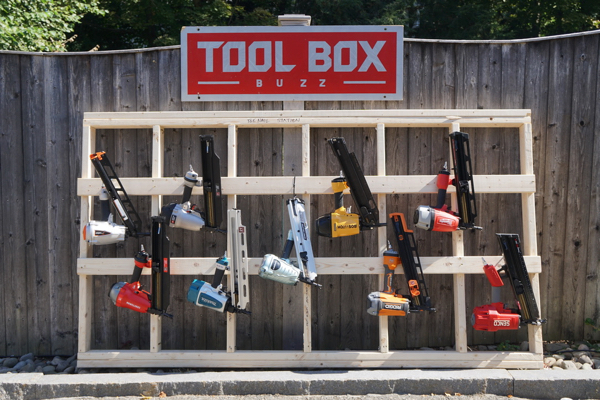
Newer building materials like engineered lumber put today'due south nailers to the test. Users can become frustrated when they have to follow upward a pneumatic nailer by paw-banging "proud" nails into LVL headers. Whether you lot're looking to avoid this frustration and desire a nailer that is powerful plenty to penetrate engineered lumber, or your new to the game, and need a "practice-information technology-all" framing nailer this Head-to-Head volition guide you on the proper choice. This test volition give you lot the information you lot need to cull the best full-size framing nailer.

Full Head, Full-Size Framing Nailer Specifications and Features
For this Head-to-Head evaluation, nailers were chosen based on the following criteria: Capable of firing up to 3-1/two″ full-head framing nails, total-size tools (nothing from the compact category), and capacity to agree at least two full strips of nails.
The challenge for any Caput-to-Head is developing the testing and evaluation criteria to create a valuable comparison for Pro users. There are many unlike tests that could exist performed. Withal, with limited fourth dimension and resource, this evaluation focuses on real earth tasks found on many of the jobs nosotros work on. These tasks have measurable and realistic applications to give yous a adept baseline on performance and expectations.
We included the following framing nailers in the Head-To-Head test:

Bostitch F21PL 21º Full Circular Head 3-i/2" Framing Nailer
- Collation Blazon: Plastic
- Depth Adjustment: Yes
- Dry Burn Lockout: No
- Fastener Length: 2″ to 3-one/2″
- Fastener Blazon / Judge: 21º
- Firing / Actuation Mode: Sequential with Boosted Trigger Included
- Magazine Chapters: 60
- Mag Loading: Lesser load
- Operating Pressure level: 80-120 psi
- Power Source: Pneumatic
- Height: 14"
- Length: 20-3/8"
- Width: five-one/4"
- Weight 8.1 lbs.
- Bostitch F21PL
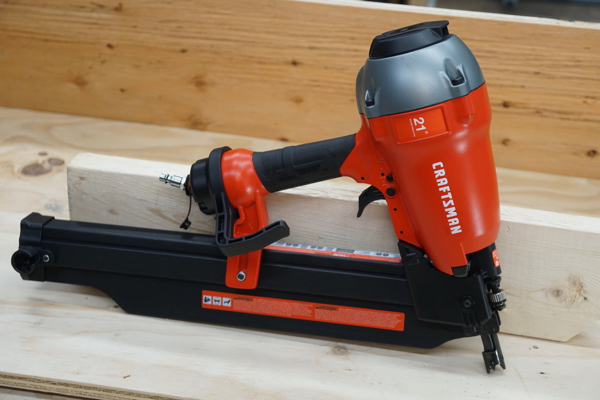
Craftsman CMP21PL 21º 3-1/ii" Framing Nailer
- Collation Type: Plastic
- Depth Adjustment: Yes
- Dry Fire Lockout: Aye
- Fastener Length: two″ to 3-i/2″
- Fastener Blazon / Estimate: 20-22º
- Firing / Actuation Mode: Tool-free selectable trigger
- Magazine Capacity: sixty
- Magazine Loading: Bottom load
- Operating Force per unit area: 70-120 psi
- Power Source: Pneumatic
- Height: xiv.76 in
- Length: 21.65 in
- Width: 4.72
- Weight viii.2 lbs.
- Craftsman CMP21PL
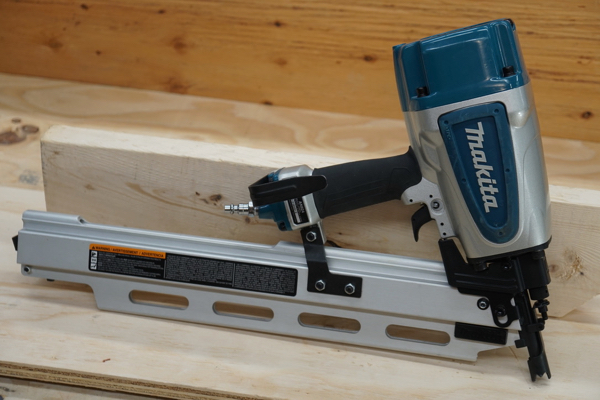
Makita AN924 21º iii‑1/2″ Framing Nailer
- Collation Type: Plastic
- Depth Adjustment: Aye
- Dry Fire Lockout: Yes
- Fastener Length: two″ to 3-1/2″
- Fastener Blazon / Estimate: 21º
- Firing / Actuation Manner: Switch – tool gratuitous
- Magazine Capacity: 73
- Magazine Loading: Top load
- Operating Force per unit area: lxx-120 psi
- Ability Source: Pneumatic
- Height: 13-three/iv"
- Length: 22"
- Width: four-five/8"
- Weight 8.3 lbs.
- Makita AN924
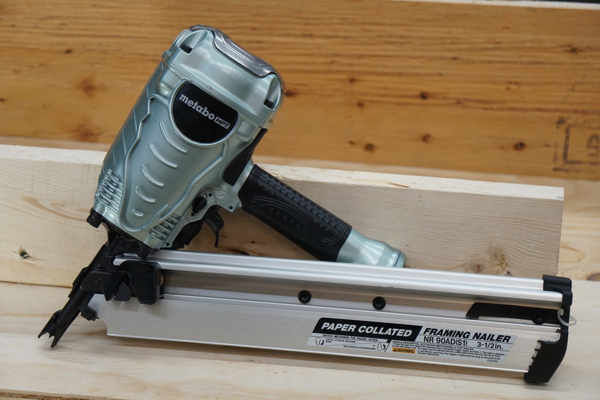
Metabo HPT NR90AD(S1) 21º 3-1/2″ Paper Collated Framing Nailer
- Collation Type: Newspaper
- Depth Adjustment: Yeah
- Dry Fire Lockout: No
- Fastener Length: 2″ to 3-1/2″
- Fastener Type / Gauge: 30º
- Firing / Actuation Manner: Tool-free selectable trigger
- Magazine Chapters: 86-94
- Magazine Loading: Rear
- Operating Pressure: lxx-120 psi
- Power Source: Pneumatic
- Height: 13-3/4
- Length: 18-three/16"
- Width: 4-15/16"
- Weight 7.0 lbs
- Metabo HPT NR90AD(S1)

Milwaukee 7200-20 21º 3-one/2″ Framing Nailer
- Collation Blazon: Plastic
- Depth Adjustment: Aye
- Dry Fire Lockout: Aye
- Fastener Length: 2″ to three-1/2″
- Fastener Type / Estimate: 20-22º
- Firing / Actuation Style: Tool-free selectable trigger
- Magazine Capacity: 64-72
- Magazine Loading: Rear
- Operating Pressure: 70-120 psi
- Power Source: Pneumatic
- Height: 14-i/4"
- Length: 21-iii/8"
- Width: iv-three/4"
- Weight 7lbs. 12 oz
- Milwaukee 7200-xx
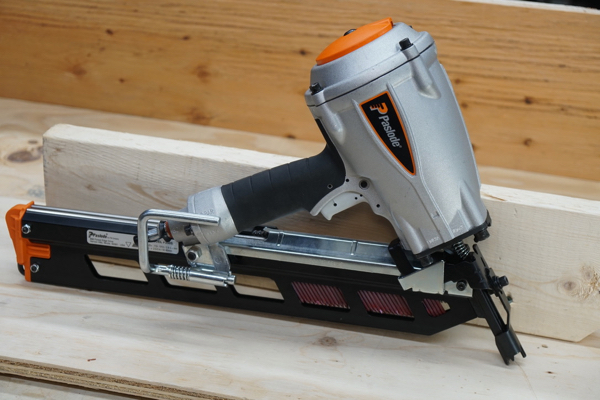
Paslode PowerMaster Plus 30º F350-S 3-1/2" Framing Nailer
- Collation Type: Paper
- Depth Adjustment: Yes
- Dry Burn Lockout: No
- Fastener Length: two″ to 3-1/2″
- Fastener Type / Gauge: 30º
- Firing / Actuation Mode: Yep
- Jam Clearance: Yes
- Mag Capacity: 84
- Magazine Loading: Rear
- Operating Pressure: fourscore-120 psi
- Power Source: Pneumatic
- Height: 13-1/2
- Length: 19.3/8"
- Width: 5-one/8
- Weight viii.four lbs.
- Paslode PowerMaster Plus

Porter-Cable FR350B 22° Framing Nailer
- Collation Type: Plastic
- Depth Aligning: Yes
- Dry out Burn down Lockout: Yes
- Fastener Length: ii″ to 3-1/2″
- Fastener Type / Gauge: 22º
- Firing / Actuation Mode: Tool-free switch
- Jam Clearance: Yes
- Magazine Capacity: 60
- Mag Loading: Lesser load
- Operating Pressure: seventy-120 psi
- Power Source: Pneumatic
- Peak: 14.76
- Length: 21.65
- Width: 4.72
- Weight 8.25 lbs.
- Porter-Cable FR350B
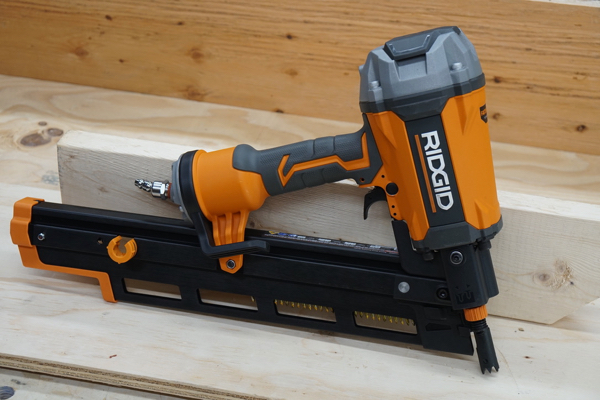
RIDGID R350RHF 21° 3-one/2 in. Framing Nailer
- Collation Blazon: Plastic
- Depth Adjustment: Yes
- Dry out Burn Lockout: Yes
- Fastener Length: 2″ to three-one/ii″
- Fastener Type / Judge: 20-22º
- Firing Actuation Fashion: Tool-free switch
- Jam Clearance: Yes
- Magazine Capacity: sixty-70
- Magazine Loading: Bottom load
- Operating Pressure: lxxx-120 psi
- Power Source: Pneumatic
- Top: 15.25"
- Length: 22.44"
- Width: 4-3/4"
- Weight 7.3 lbs
- Ridgid R350RHF

Senco FramePro 752XP 3 1/2″ Framing Nailer
- Collation Type: Plastic
- Depth Aligning: Yes
- Dry Fire Lockout: Yes
- Fastener Length: 2″ to 3-1/2″
- Fastener Blazon /Gauge: 20º
- Firing/Actuation Manner: Sequential with Additional Trigger Included
- Jam Clearance: Yeah
- Mag Capacity: 60
- Magazine Loading: Bottom load
- Operating Pressure: 70-120 psi
- Ability Source: Pneumatic
- Height: xiv.1/iv
- Length: 20"
- Width: iv-3/16
- Weight viii.7 lbs.
- Senco FramePro 752XP

All-time Features
WINNER – Milwaukee
There were a few stand-out features that affect operation and condom. Each tool was ranked, using a 1 thru 5 score, one being the all-time, to decide the tool with the best feature ranking. A listing of some of them are included below.
The Milwaukee took first place with Makita close on their heels. The squad felt that the two nailers were almost equal with the Milwaukee having a slightly better contact tip. 3rd place was the RIDGID and Senco.
| Contact Tip | Depth Adjustmt. | Fire Mode | Rafter Claw | Dry Fire Lock Out | Totals | |
|---|---|---|---|---|---|---|
| Milwaukee | 2 | 1 | i | 2 | 1 | 7 |
| Makita | three | ane | 1 | two | 1 | 8 |
| Ridgid | 2 | 1 | 3 | four | i | 11 |
| Senco | 1 | ii | five | 2 | 1 | 11 |
| Metabo HT | 3 | 4 | 1 | five | i | 14 |
| Paslode | 3 | v | five | 1 | one | fifteen |
| Bostitch | 2 | 3 | 5 | 3 | v | 18 |
| Craftsman | 5 | 4 | 4 | four | one | 18 |
| Porter-Cable | five | 4 | 4 | 4 | ane | 18 |
Nail Loading
During this evaluation there was no consensus on a preference for top-loading vs. lesser loading nailers. For top-loading, the squad chose the Paslode and felt that the two steel guide rails facilitated smoother nail loading and were more durable. For lesser loading, the team felt the Milwaukee was superior and its nail pusher release push button was the easiest to employ and most attainable.
In this head-to-head, iii-1/2″ full, round head nails were used. All merely the Metabo HPT used plastic collated nails. The Metabo HPT tested, used paper tape Paslode RoundDrive nails. These nails are full-head, offset nails, as opposed to total-head concentric. The commencement is due to the angle of the mag, which is 30 degrees vs. 21-degree total-caput concentric blast.

Contact Tip
Having a well-designed contact tip ensures the nailer does not slip and prevents nails from existence installed incorrectly. The best contact tip in this test was the Senco. The Senco stood solitary in this pack; it provided 360-caste coverage around the firing head and had more circuitous tangs to grip material without limiting access to tighter spaces.
Other nailers with not bad contact tips are the Milwaukee, RIDGID, and BOSTITCH. Rounded and aggressive, these contact tips quickly gripped all the materials tested and were consistent in their performance.

During the testing, we noticed that the Metabo HPT contact tip didn't grab well at steeper angles when toe-nailing. The Craftsman and Porter-Cable, accept identical tips, with tangs that are apartment and not ground to a abrupt point. We establish them to slide on harder materials like the AdvanTech sheathing and LVL framing lumber.
The BOSTITCH is the only nailer that comes with a replacement tip that is a positive-placement nailer tip for metal connectors.

Depth Aligning
The Makita, Milwaukee, and RIDGID stood out with the best placed, smoothest-to-operate depth of drive knob adjustment. On the Makita, we liked the visible scale that allows you to see the adjustment range.The Milwaukee and RIDGID both accept a large aligning wheel, only it'southward hard to tell where in the depth aligning you are compared to the other nailers. The Senco'southward big knurled knob aligning was the easiest to operate, and adjustment is smooth. Information technology's merely negative is that it is straight in the line of sight.

An onboard Allen wrench is necessary for depth adjustments on the Paslode nailer. This method is an old-fashioned arroyo, and the Paslode nailer's scoring suffered as a result.
Near all of the nailers now take a tool-less adjustment punch. The BOSTITCH sports a unique tool-less "SLIDE" adjustment, which gives the user the benefit of speed, particularly at farthermost changes. We found the BOSTITCH aligning easy, the tip completely slides in and out, but this could eventually be a concern due to the tip eventually falling out and get lost. The squad felt that the nailers with a dial aligning, a tried-and-true design, were more than rugged and sensitive to minor tweaks, compared to the Bostitch slide model.

Clearing Jambs
Nearly jams are caused past a fastener, or office of a nail, jamming betwixt the driver bract and the boom guide. Fastener strips with an wrong collation angle or the incorrect fastener type, (such every bit clipped caput fasteners) may also cause continuous jamming.
To articulate the jamb for all the nailers, except Senco:
- Disconnect the air supply
- Remove fasteners
- Insert a screwdriver or pin dial into the boom guide to push back the driver blade
- Once the commuter blade is back in position, remove the nail or nail fragment with needle-nose pliers, if necessary
The Senco has a single-commodities, magazine removal procedure, for immigration stubborn blast jambs. An adjustable wrench or pair of pliers allows the user to loosen the commodities (not remove information technology), and the magazine slides out of the olfactory organ of the gun, allowing access to clear a jamb. This unique feature was simple and piece of cake to do for jam clearing.

Sequential / Bump Burn down Mode
All the nailers are capable of single fire fashion, and sequential [bump] firing. For applications that take a consistent and repeating nailing pattern, similar strapping or sheathing; bump-burn saves time and requires less endeavor on the part of the user.
Milwaukee had the best combination of "ease-of-use," and safety and Makita followed in 2d place. Both nailers switch betwixt firing modes by rotating switch. Milwaukee has a locking, rotating switch [push and twist], Makita has a simple switch with no lock or secondary actuation on the rotating mode switch.
The Craftsman, Porter-Cable and RIDGID have has a push-button, on one side of the trigger, that releases the selectable trigger knob and allows it to rotate. The just drawback is that it requires a two-handed functioning.
The Craftsman and the Porter-Cable likewise accept a trigger lock out.

Swapping Out The Trigger
The Bostitch, Paslode, and Senco tools require that the trigger be swapped out, to change firing modes, between sequential and bump fire. While this isn't ideal for a "do-it-all," framing gun, it'southward typical for full-time framers who apply task-specific guns and operate in generally the bump firing mode.

Rafter Claw
Iii nailers tested have metal rafter hooks: Paslode, Senco, and Makita. The team felt that Paslode has the BEST hook. Paslode's bound-loaded hook has a 2-1/2″ opening. This claw is not reversible, has a 180-degree swing, and iii detent positions [it locks in a stored position, at 90 degrees, and likewise swings confronting the magazine.]
The Senco 2-inch rafter hook is smaller profile and rounded, and seems more suited for a ladder rung – it almost seems similar it was an reconsideration. The Senco hook is a 180-degree swivel and is not reversible.
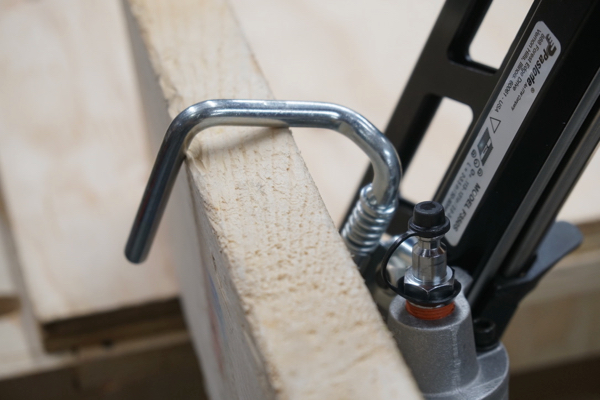
MAKITA has a fixed metallic hook that is reversible by removing screws. Information technology has two fixed-width options; ane-one/2″ or 2-ane/two″ broad. The team institute Makita's hook sturdy, durable, and reliable.
I like this hook (Makita) it'south solid, and you know exactly what to expect! ~ ROB
While not fans of plastic hooks, the Milwaukee and Bostitch were the all-time. MILWAUKEE's hook is bulky, with a 1-1/2 opening. This hook has some flex but swivels hands. Bostitch is a shorter hook, with locking indents, positioned high on gun, and is like shooting fish in a barrel to use.
The Metabo HPT nailer, we tested, does not come with a rafter hook, a feature we feel is a MUST on a framing nailer (other Metabo HPT nailers exercise come with a hook). The RIDGID'south rafter claw is easy to swivel, but the team felt that the hook was besides narrow, barely fits on 2x lumber. It also seems thinner and less durable.
Dry Burn down Lockout
This characteristic prevents the nailer from firing when out of nails. Many manufacturers include this feature because it avoids unnecessary wear. It too eliminates the frustration of firing the nailer and discovering that the user has non set up a nail. Bostitch is the simply nailer without a dry out fire lockout and was marked downward for this. The team felt that lock-out is an important characteristic that Pros adopt.

No-Mar Tip
Our crew members do not use a no-mar tip on a framing nailer – ever! If you were building a deck or dock using PT decking or maybe installing that horrible T-111 siding, maybe you would want to protect the forest surface. That said, the nailers with no-mar tips stored them in such a way as to guarantee they volition go lost. As a result nosotros decided not to score this category.

Weight And Size
WINNER – Metabo HPT
The length, width, and summit of the nailers were used to determine their cubic volume, and the rank was assigned based on volume and tool weight. In the accompanying graph, the right column is the size ranking of the nailer, and the left column is the weight ranking.
The Metabo HPT was the smallest and lightest nailer nosotros tested and its size was a favorite among the team. Coming in 2nd was Milwaukee followed past Makita.
Smash Magazine Capacity
WINNER – Metabo HPT
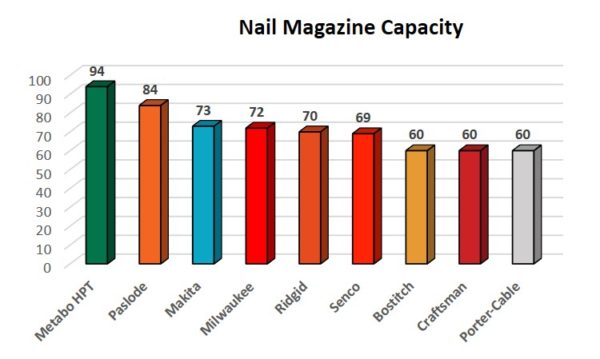
For a full-size framer, most folks volition agree that you want the nailer to have a ii-strip blast capacity. All of these nailers hold two strips. Some had a slightly higher capacity.
Noise/Decibels
We measured the decibel levels during the LVL header testing and recorded the results at a consistent, waist-high distance. Decibels were recorded at peak levels. Equally you tin run into below, these nailers are very close and so we did not rank them. It's of import to note that all of these nailer require hearing protection.

Noise is a severe hazard in construction. So any tool that offers lower sound signatures is essential to know. OSHA requires a hearing conservation program in place if workers are exposed to a time-weighted average (TWA) noise level of 85 decibels (dBA) or higher over an 8-60 minutes work shift.

Ergonomics
WINNER – Makita and Milwaukee
The nailers are essentially the same from an ergonomic standpoint, but iii nailers stood out as meridian contenders; Makita, Milwaukee, and Metabo HPT. Nosotros looked at how the tool interfaced with the user concerning the following five categories:
- Grip
- Rafter Hook
- Ease of Firing Fashion
- Ease of Depth Adjustments
- Balance
Each tool was ranked on each category above. The squad used a 1 thru 5 score, ane being the best, to determine the tool with the best ergonomic ranking.
| Grip | Rafter Claw | Trigger Choice | Balance | Depth Adjustment | Setting Adjustments | Totals | |
|---|---|---|---|---|---|---|---|
| Makita | 2 | ii | ane | ii | 1 | 1 | 9 |
| Milwaukee | ane | 2 | 1 | 2 | 2 | one | ix |
| Metabo HPT | 2 | 5 | 1 | 1 | four | 3 | 16 |
| Paslode | one | 1 | 5 | ane | 5 | v | xviii |
| Bostitch | 3 | 3 | 5 | 3 | 4 | 2 | xx |
| Ridgid | 4 | iv | iii | 4 | 2 | 3 | xx |
| Senco | 4 | 2 | 5 | iii | 3 | four | 21 |
| Craftsman | 5 | 4 | 4 | 5 | 3 | iii | 24 |
| Porter Cable | 5 | 4 | 4 | five | 3 | iii | 24 |

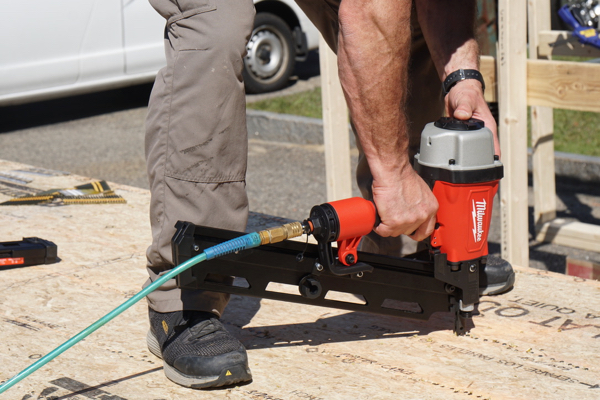
All iii nailers had superior nailing fashion selector switches. The Makita and Milwaukee had easier to use depth adjustments. The Metabo HPT has a clear line of sight, just the awkward placement of the depth adjustment is the trade-off. The location of the depth of drive does results in this nailer having the All-time sightline in our test.
The Metabo HPT has a beautiful line of sight ~ STAN
The Makita and Milwaukee tied for first place in ergonomics and were well alee of the pack. They came in 7 points alee of the Metabo HPT, 9 points ahead of Paslode, and x-plus points ahead of the rest.

Toe-Nailing Evaluation
WINNER – Senco
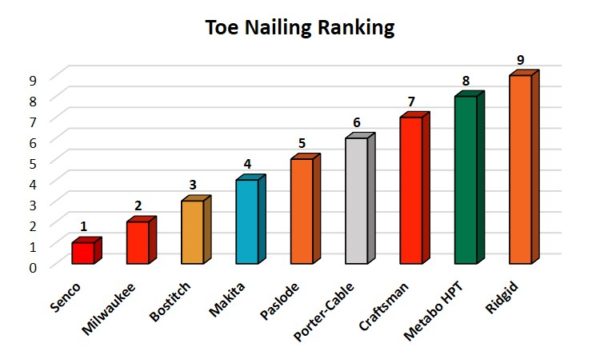
When toe-nailing, a nailer is held at approximately lx degrees. Many framing nailer contact-tips skid in these situations, and the nailers with the most aggressive contact tip will toe-smash improve. For toe-nailing framing applications, nosotros used 3-1/2" nails to fasten 2×4 KD framing stud at an angle.

The Senco has the best tip. It has a "hook-like," super aggressive tip that toe-nails well, with enough of power. Milwaukee also has an aggressive tip, was powerful with solid and fully consistent toe-nailing. The Bostitch nailer has plenty of ability, and it's aggressive jumpsuit, cast-tip gripped well. The Makita nailer was "smoothen!" It sank toenails consistently and is a powerful nailer. Nosotros'd like to see a more than ambitious tip for toe-nailing.

The Metabo HPT nailer is smaller than the residual and easily fits between studs. The contact-tip was ambitious and gipped the wood well. The team found that the Metabo HPT was slightly underpowered, with inconsistent toe-nailing penetration.
The RIDGID nailer did not perform well in our toe-nailing examination. Power wasn't the result, and this nailer did well in our other tests. However, the RIDGID nailer was not able to sink toe-nails even at a maximum-depth setting and with the nose of the gun firmly buried in the woods.

Heavy-Duty Framing LVL Awarding – Power Test
WINNER – Senco
For this application, we used 3-1/2" framing nails to fasten LVL headers together. We placed two ane-3/four″ thick LVLs together, with a ii×8 underneath and face nailed. Each nailer installed a serial of 10 fasteners, to compile an average measurement for nail penetration. Nosotros used the aforementioned compressor on all nailers and cycled the compressor to achieve maximum tank air force per unit area, prior to starting each and every test.
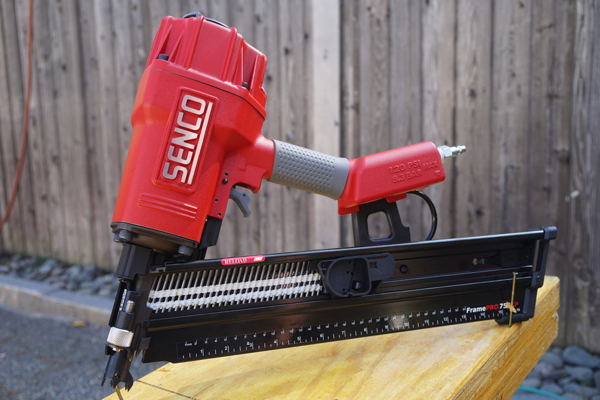
During the evaluation of Ability (depth of drive) the nailers were evaluated in two different ways:
- Test 1: Testers set the nailers to approximately the "mid depth of drive" setting to get a sense of the average depth of drive.
- Test 2: This test was used to rank the nailers. Each nailer was gear up to it'southward maximum depth of bulldoze and the average depth of drive was measured for each.
The tests were run multiple times, and the results were compiled and an average determined. The chart below gives the average depth of drive in inches, with the nailers fix to their maximum depth of drive.
The SENCO had the best power and was able to consistently "over-drive" fasteners on every nail.
The SENCO walked away with the ability exam! ~ Stan Durlacher [TBBCrew]
The RIDGID in terms of power performed extremely well coming in 2nd. Following closely in third place was the Milwaukee which had very low kickback and impressed the team.

The advantages of pneumatic nailers are clear regarding power, productivity and capacity. The disadvantages commonly expressed among tradesmen are weight, compressor, hose, and maintenance. ~ Stan Durlacher [TBBCrew]

Medium Duty Framing Application – AdvanTech 3/4″ Sheathing Over LVL Studs
For this subjective application, we used 2-1/2" long framing nails to fasten 3/four″ AdvanTech sheathing to engineered studs (LVL). We did find that all the nailers were able to perform this task and achieve full penetration with very few nails that were not fully seated.
The Makita, Metabo, Senco and Paslode performed slightly ameliorate than the remainder of the pack, but not enough to create a score ranking.

Framing contractors switch to a coil nailer for most sheathing applications like sub-floors, walls, and covering. All the same, many carpenters own and operate Simply one framing nailer. For those contractors, having the ability to adjust fastener depth when transitioning from framing walls to sheathing is important. In this state of affairs, depth adjustment hurts the older mode tools that require an Allen wrench depth adjustment over using a tool-less adjustment.

"I but desire to keep on firing nails with this (Senco) gun!" -Ethan Bickford [TBBCrew]during the sub-flooring test

Overhead Fastening Application
WINNER – Metabo HPT
For the overhead application, our intent was to appraise operation and ergonomics in an overhead application. 3/4″ Pine strapping was fastened to LVL studs with 2-1/two" ring shank nails. No performance issues with fastening were noted.

The Metabo HPT due to its lightweight pattern, was easier to position and maneuver and will apparently cause less shoulder and neck fatigue. All the other nailers were heavy for this job. The nailing pattern of two ring shank nails per joist/strapping connection makes for quick work with the advantages of a crash-land burn down fashion. However, ane effect that does stand out for this chore is the added weight of the other nailers, specially the Bostitch and Senco . The extra weight of these nailers can exist a pregnant gene for user fatigue when using the tool for extended periods of time like nailing ceiling strapping.
Pricing
WINNER – Metabo HPT
Pricing fluctuates constantly so keep in mind the pricing listed here was at the time of this publication and may exist different. Pricing listed is from independent retailers that we trust for great service and so go on that in mind, some lower prices may be out there from less reputable retailers. There was a necktie on pricing for this examination but the nailers were different enough that nosotros were able to rank one higher up all others based on the quality of the tool and outstanding value!
Metabo HPT and Porter Cablevision tied at $199.00. The team felt that the BEST nailer of the two, in nearly all other tests, was the Metabo HPT and awarded it kickoff identify in this category. Coming in at 3rd identify was the Bostitch and Craftsman both listed at $219.00.
Information technology'southward important to understand that price is but i benchmark in choosing the all-time nailer, with over-all performance topping that list.
Purchase Now From Our Sponsored Retailers
Other Options
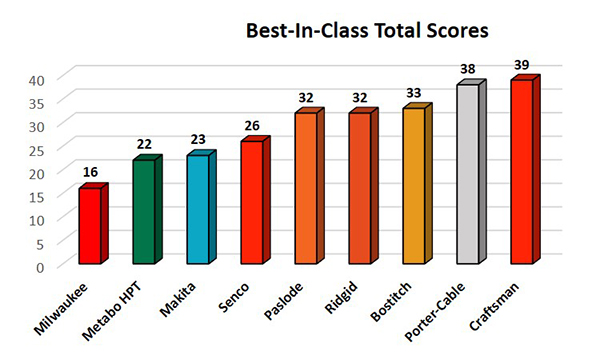
All-time Total-Size Framing Nailer
WINNER – Milwaukee
Each tool was ranked in each category to a higher place. All of the categories ranked were then totaled to determine the total score to determine the Best Total-Size Framing Nailer.
The Milwaukee nailer is not new, and its stellar performance surprised the team. When it comes to pneumatic full-size framing nailers, the Milwaukee 7200-twenty surely ranks at the top of the list when ability, operation, ergonomics, and features are concerned. It came in at a total of xvi points, which was six-points ahead of the second-placed Metabo HPT, and 7-points alee of the third-place Makita. [See Chart Below]
| Ability | Smash Cap. | Toe Smash | Size | Ergo | Features | Price | Total | Rank | |
|---|---|---|---|---|---|---|---|---|---|
| Milwaukee | 2 | 4 | 2 | two | 1 | 1 | iv | 16 | 1 |
| Metabo HPT | 4 | 1 | viii | 1 | three | 4 | 1 | 22 | ii |
| Makita | half dozen | 3 | 4 | 3 | 1 | two | iv | 23 | three |
| Senco | ane | 6 | one | 4 | 5 | iii | 6 | 26 | 4 |
| Paslode | viii | 2 | 5 | 4 | iii | 5 | 5 | 32 | 5 |
| Bostitch | iii | 7 | 3 | 7 | 4 | half-dozen | 3 | 33 | 6 |
| Porter-Cable | 5 | 7 | 6 | half-dozen | 6 | 6 | 2 | 38 | vii |
| Ridgid | 2 | 5 | 9 | five | 4 | 3 | four | 32 | 5 |
| Craftsman | vii | seven | 7 | 6 | 6 | six | three | 39 | 8 |
Final Thoughts – Best Full-Size Framing Nailer
We get lots of comments almost how we make the terminal rankings. As we've stated, there are hundreds of ways to compare tools. The adept news is nosotros've openly shared ALL the information from our tests, and you can rank the tools however you want. Don't care about the price? No problem eliminate that from the matrix to a higher place and re-rank them. Hopefully, y'all'll find this Caput-To-Head useful in comparing a wide range of full-size pneumatic framing nailers.

Did You Know …..
Interesting Fact On Nailer "Kickback"
Kickback is a product of a few factors, tool weight, the density of the textile beingness nailed, size of the fastener, and the speed with which force is applied to the fastener. Kickback was a hard problem to overcome in the early days of pneumatic nailers. In short, manufacturers needed to exist able to overcome kickback, resulting in a few solutions developed effectually the same fourth dimension but in the end, a "pop-it" valve adult for ejection seats on fighter planes was adapted for utilize in nail guns and that is essentially the same applied science used in pneumatic nailers today.
Source: Tools of The Merchandise –A Cursory History of Portable Nail Guns past Don Carlson
Best Framing Nailer Video Review
Source: https://www.toolboxbuzz.com/head-to-head/best-full-size-framing-nailer-head-to-head/

Post a Comment for "3 1/2 Inch Round Head Nail Gun Reviews"