Other Than Constantinople Where Can Byzantine Art Be Seen
Byzantine art comprises the body of Christian Greek artistic products of the Eastern Roman (Byzantine) Empire,[1] too as the nations and states that inherited culturally from the empire. Though the empire itself emerged from the decline of Rome and lasted until the Fall of Constantinople in 1453,[2] the start engagement of the Byzantine flow is rather clearer in art history than in political history, if still imprecise. Many Eastern Orthodox states in Eastern Europe, as well as to some caste the Islamic states of the eastern Mediterranean, preserved many aspects of the empire'southward culture and art for centuries after.
A number of contemporary states with the Byzantine Empire were culturally influenced by it without actually being part of it (the "Byzantine commonwealth"). These included the Rus, as well every bit some non-Orthodox states similar the Republic of Venice, which separated from the Byzantine Empire in the tenth century, and the Kingdom of Sicily, which had shut ties to the Byzantine Empire and had also been a Byzantine territory until the 10th century with a large Greek-speaking population persisting into the twelfth century. Other states having a Byzantine artistic tradition, had oscillated throughout the Middle Ages between existence role of the Byzantine Empire and having periods of independence, such as Serbia and Republic of bulgaria. After the fall of the Byzantine capital of Constantinople in 1453, art produced by Eastern Orthodox Christians living in the Ottoman Empire was ofttimes called "post-Byzantine." Certain artistic traditions that originated in the Byzantine Empire, particularly in regard to icon painting and church building architecture, are maintained in Greece, Cyprus, Serbia, Bulgaria, Romania, Russian federation and other Eastern Orthodox countries to the nowadays day.
Introduction [edit]

Byzantine art originated and evolved from the Christianized Greek culture of the Eastern Roman Empire; content from both Christianity and classical Greek mythology were artistically expressed through Hellenistic modes of mode and iconography.[3] The art of Byzantium never lost sight of its classical heritage; the Byzantine capital letter, Constantinople, was adorned with a large number of classical sculptures,[4] although they somewhen became an object of some puzzlement for its inhabitants[v] (however, Byzantine beholders showed no signs of puzzlement towards other forms of classical media such as wall paintings[6]). The basis of Byzantine fine art is a fundamental artistic attitude held by the Byzantine Greeks who, like their aboriginal Greek predecessors, "were never satisfied with a play of forms lone, but stimulated by an innate rationalism, endowed forms with life past associating them with a meaningful content."[7] Although the fine art produced in the Byzantine Empire was marked by periodic revivals of a classical artful, information technology was in a higher place all marked by the development of a new aesthetic defined past its salient "abstruse", or anti-naturalistic grapheme. If classical art was marked by the attempt to create representations that mimicked reality equally closely every bit possible, Byzantine art seems to accept abandoned this try in favor of a more symbolic approach.
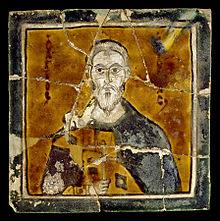
The Ethiopian Saint Arethas depicted in traditional Byzantine style (10th century)
The nature and causes of this transformation, which largely took place during late antiquity, take been a subject area of scholarly debate for centuries.[eight] Giorgio Vasari attributed it to a refuse in creative skills and standards, which had in plow been revived past his contemporaries in the Italian Renaissance. Although this bespeak of view has been occasionally revived, most notably by Bernard Berenson,[ix] modern scholars tend to take a more than positive view of the Byzantine aesthetic. Alois Riegl and Josef Strzygowski, writing in the early 20th century, were above all responsible for the revaluation of late antique art.[10] Riegl saw it as a natural evolution of pre-existing tendencies in Roman fine art, whereas Strzygowski viewed information technology as a product of "oriental" influences. Notable recent contributions to the debate include those of Ernst Kitzinger,[11] who traced a "dialectic" between "abstruse" and "Hellenistic" tendencies in late antiquity, and John Onians,[12] who saw an "increase in visual response" in late artifact, through which a viewer "could look at something which was in twentieth-century terms purely abstract and detect information technology representational."
In any case, the contend is purely modern: it is clear that most Byzantine viewers did non consider their art to be abstract or unnaturalistic. As Cyril Mango has observed, "our own appreciation of Byzantine art stems largely from the fact that this art is not naturalistic; withal the Byzantines themselves, judging by their extant statements, regarded it as being highly naturalistic and as being straight in the tradition of Phidias, Apelles, and Zeuxis."[13]
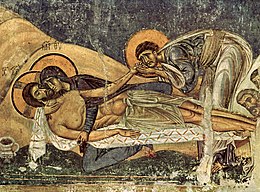
Frescoes in Nerezi nearly Skopje (1164), with their unique blend of high tragedy, gentle humanity, and homespun realism, anticipate the approach of Giotto and other proto-Renaissance Italian artists.
The subject field matter of monumental Byzantine art was primarily religious and imperial: the two themes are often combined, as in the portraits of later Byzantine emperors that decorated the interior of the sixth-century church of Hagia Sophia in Constantinople. These preoccupations are partly a result of the pious and autocratic nature of Byzantine guild, and partly a consequence of its economic structure: the wealth of the empire was concentrated in the hands of the church and the imperial function, which had the greatest opportunity to undertake monumental artistic commissions.
Religious art was not, however, limited to the awe-inspiring ornamentation of church interiors. One of the most important genres of Byzantine art was the icon, an prototype of Christ, the Virgin, or a saint, used as an object of veneration in Orthodox churches and private homes akin. Icons were more religious than aesthetic in nature: especially after the end of iconoclasm, they were understood to manifest the unique "presence" of the figure depicted by means of a "likeness" to that figure maintained through carefully maintained canons of representation.[xiv]
The illumination of manuscripts was another major genre of Byzantine art. The about usually illustrated texts were religious, both scripture itself (peculiarly the Psalms) and devotional or theological texts (such as the Ladder of Divine Ascent of John Climacus or the homilies of Gregory of Nazianzus). Secular texts were also illuminated: of import examples include the Alexander Romance and the history of John Skylitzes.
The Byzantines inherited the Early Christian distrust of monumental sculpture in religious art, and produced only reliefs, of which very few survivals are annihilation like life-size, in sharp contrast to the medieval art of the Westward, where awe-inspiring sculpture revived from Carolingian art onwards. Modest ivories were too more often than not in relief.
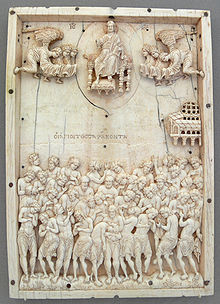
The and so-called "minor arts" were very important in Byzantine art and luxury items, including ivories carved in relief equally formal presentation Consular diptychs or caskets such as the Veroli catafalque, hardstone carvings, enamels, drinking glass, jewelry, metalwork, and figured silks were produced in big quantities throughout the Byzantine era. Many of these were religious in nature, although a large number of objects with secular or non-representational ornamentation were produced: for instance, ivories representing themes from classical mythology. Byzantine ceramics were relatively crude, as pottery was never used at the tables of the rich, who ate off Byzantine silver.
Periods [edit]
Byzantine art and architecture is divided into 4 periods by convention: the Early catamenia, commencing with the Edict of Milan (when Christian worship was legitimized) and the transfer of the imperial seat to Constantinople, extends to Ad 842, with the conclusion of Iconoclasm; the Eye, or loftier period, begins with the restoration of the icons in 843 and culminates in the Fall of Constantinople to the Crusaders in 1204; the Late period includes the eclectic osmosis between Western European and traditional Byzantine elements in art and compages, and ends with the Autumn of Constantinople to the Ottoman Turks in 1453. The term post-Byzantine is then used for later on years, whereas "Neo-Byzantine" is used for art and compages from the 19th century onwards, when the dissolution of the Ottoman Empire prompted a renewed appreciation of Byzantium by artists and historians akin.
Early on Byzantine art [edit]

2 events were of fundamental importance to the development of a unique, Byzantine art. First, the Edict of Milan, issued past the emperors Constantine I and Licinius in 313, immune for public Christian worship, and led to the development of a awe-inspiring, Christian art. Second, the dedication of Constantinople in 330 created a slap-up new artistic heart for the eastern one-half of the Empire, and a specifically Christian ane. Other artistic traditions flourished in rival cities such as Alexandria, Antioch, and Rome, merely it was not until all of these cities had fallen - the showtime ii to the Arabs and Rome to the Goths - that Constantinople established its supremacy.
Constantine devoted great endeavour to the decoration of Constantinople, adorning its public spaces with ancient statuary,[15] and edifice a forum dominated past a porphyry column that carried a statue of himself.[16] Major Constantinopolitan churches congenital under Constantine and his son, Constantius II, included the original foundations of Hagia Sophia and the Church of the Holy Apostles.[17]
The next major building campaign in Constantinople was sponsored by Theodosius I. The most of import surviving monument of this period is the obelisk and base erected by Theodosius in the Hippodrome[18] which, with the large silvery dish chosen the Missorium of Theodosius I, represents the classic examples of what is sometimes called the "Theodosian Renaissance". The earliest surviving church in Constantinople is the Basilica of St. John at the Stoudios Monastery, congenital in the 5th century.[xix]
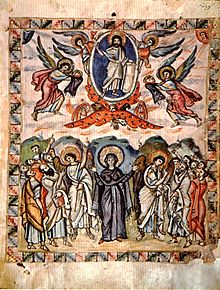
Miniatures of the 6th-century Rabula Gospel (a Byzantine Syriac Gospel) display the more than abstract and symbolic nature of Byzantine art
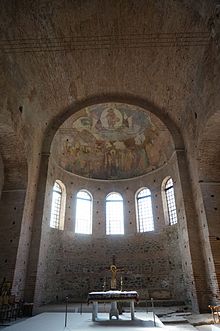
Due to subsequent rebuilding and destruction, relatively few Constantinopolitan monuments of this early period survive. Even so, the development of monumental early Byzantine art tin can still be traced through surviving structures in other cities. For instance, of import early churches are found in Rome (including Santa Sabina and Santa Maria Maggiore),[20] and in Thessaloniki (the Rotunda and the Acheiropoietos Basilica).[21]
A number of important illuminated manuscripts, both sacred and secular, survive from this early period. Classical authors, including Virgil (represented by the Vergilius Vaticanus[22] and the Vergilius Romanus)[23] and Homer (represented past the Ambrosian Iliad), were illustrated with narrative paintings. Illuminated biblical manuscripts of this menstruum survive only in fragments: for instance, the Quedlinburg Itala fragment is a small portion of what must have been a lavishly illustrated copy of ane Kings.[24]
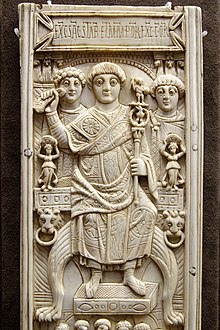
Early Byzantine fine art was also marked by the tillage of ivory carving.[25] Ivory diptychs, frequently elaborately decorated, were issued as gifts by newly appointed consuls.[26] Silverish plates were another of import form of luxury art:[27] amongst the most lavish from this menstruum is the Missorium of Theodosius I.[28] Sarcophagi continued to be produced in great numbers.
Age of Justinian I [edit]
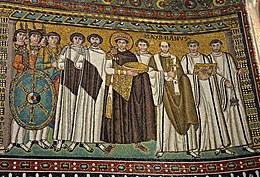
Mosaic from San Vitale in Ravenna, showing the Emperor Justinian and Bishop Maximian, surrounded past clerics and soldiers.

Meaning changes in Byzantine art coincided with the reign of Justinian I (527–565). Justinian devoted much of his reign to reconquering Italian republic, North Africa and Espana. He too laid the foundations of the royal absolutism of the Byzantine state, codifying its laws and imposing his religious views on all his subjects by law.[29]
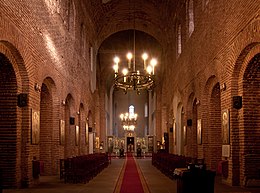
A significant component of Justinian'due south projection of majestic renovation was a massive edifice program, which was described in a book, the Buildings, written by Justinian'due south court historian, Procopius.[30] Justinian renovated, rebuilt, or founded afresh countless churches inside Constantinople, including Hagia Sophia,[31] which had been destroyed during the Nika riots, the Church of the Holy Apostles,[32] and the Church of Saints Sergius and Bacchus.[33] Justinian as well congenital a number of churches and fortifications outside of the purple capital letter, including Saint Catherine's Monastery on Mount Sinai in Egypt,[34] Basilica of Saint Sofia in Sofia and the Basilica of St. John in Ephesus.[35]
Several major churches of this flow were congenital in the provinces by local bishops in imitation of the new Constantinopolitan foundations. The Basilica of San Vitale in Ravenna, was built by Bishop Maximianus. The ornamentation of San Vitale includes important mosaics of Justinian and his empress, Theodora, although neither ever visited the church building.[36] Also of note is the Euphrasian Basilica in Poreč.[37]
Contempo archeological discoveries in the 19th and 20th centuries unearthed a large grouping of Early Byzantine mosaics in the Centre East. The eastern provinces of the Eastern Roman and afterwards the Byzantine Empires inherited a strong artistic tradition from Late Antiquity. Christian mosaic art flourished in this area from the 4th century onwards. The tradition of making mosaics was carried on in the Umayyad era until the end of the eighth century. The nearly of import surviving examples are the Madaba Map, the mosaics of Mountain Nebo, Saint Catherine's Monastery and the Church building of St Stephen in ancient Kastron Mefaa (now Umm ar-Rasas).
The first fully preserved illuminated biblical manuscripts engagement to the kickoff half of the sixth century, most notably the Vienna Genesis,[38] the Rossano Gospels,[39] and the Sinope Gospels.[xl] The Vienna Dioscurides is a lavishly illustrated botanical treatise, presented as a souvenir to the Byzantine aristocrat Julia Anicia.[41]
Important ivory sculptures of this menstruum include the Barberini ivory, which probably depicts Justinian himself,[42] and the Archangel ivory in the British Museum.[43] Silver plate continued to be decorated with scenes drawn from classical mythology; for example, a plate in the Cabinet des Médailles, Paris, depicts Hercules wrestling the Nemean lion.[44]
Seventh-century crisis [edit]
The Age of Justinian was followed by a political decline, since almost of Justinian'south conquests were lost and the Empire faced acute crisis with the invasions of the Avars, Slavs, Persians and Arabs in the 7th century. Constantinople was also wracked by religious and political disharmonize.[45]
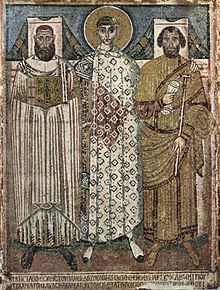
The most significant surviving monumental projects of this period were undertaken outside of the imperial upper-case letter. The church of Hagios Demetrios in Thessaloniki was rebuilt after a fire in the mid-seventh century. The new sections include mosaics executed in a remarkably abstract style.[46] The church of the Koimesis in Nicaea (present-day Iznik), destroyed in the early on 20th century but documented through photographs, demonstrates the simultaneous survival of a more classical style of church building decoration.[47] The churches of Rome, withal a Byzantine territory in this period, also include important surviving decorative programs, especially Santa Maria Antiqua, Sant'Agnese fuori le mura, and the Chapel of San Venanzio in San Giovanni in Laterano.[48] Byzantine mosaicists probably also contributed to the decoration of the early Umayyad monuments, including the Dome of the Stone in Jerusalem and the Bully Mosque of Damascus.[49]
Important works of luxury art from this flow include the argent David Plates, produced during the reign of Emperor Heraclius, and depicting scenes from the life of the Hebrew king David.[50] The most notable surviving manuscripts are Syriac gospel books, such every bit the so-chosen Syriac Bible of Paris.[51] However, the London Catechism Tables bear witness to the standing production of lavish gospel books in Greek.[52]
The period between Justinian and iconoclasm saw major changes in the social and religious roles of images within Byzantium. The veneration of acheiropoieta, or holy images "not made by human hands," became a significant phenomenon, and in some instances these images were credited with saving cities from military set on. Past the end of the 7th century, certain images of saints had come up to be viewed as "windows" through which one could communicate with the figure depicted. Proskynesis before images is also attested in texts from the late seventh century. These developments marker the beginnings of a theology of icons.[53]
At the aforementioned time, the fence over the proper part of fine art in the ornamentation of churches intensified. Iii canons of the Quinisext Council of 692 addressed controversies in this surface area: prohibition of the representation of the cross on church building pavements (Canon 73), prohibition of the representation of Christ equally a lamb (Canon 82), and a full general injunction against "pictures, whether they are in paintings or in what way so ever, which attract the center and corrupt the mind, and incite it to the enkindling of base pleasures" (Canon 100).
Crisis of iconoclasm [edit]

Helios in his chariot, surrounded by symbols of the months and of the zodiac. From Vat. Gr. 1291, the "Handy Tables" of Ptolemy, produced during the reign of Constantine Five
Intense debate over the role of fine art in worship led eventually to the menstruation of "Byzantine iconoclasm."[54] Desultory outbreaks of iconoclasm on the part of local bishops are attested in Asia Minor during the 720s. In 726, an underwater earthquake between the islands of Thera and Therasia was interpreted by Emperor Leo Three as a sign of God'southward anger, and may have led Leo to remove a famous icon of Christ from the Chalke Gate exterior the regal palace.[55] However, iconoclasm probably did non become imperial policy until the reign of Leo'due south son, Constantine V. The Council of Hieria, convened under Constantine in 754, proscribed the industry of icons of Christ. This inaugurated the Iconoclastic menses, which lasted, with interruptions, until 843.
While iconoclasm severely restricted the role of religious art, and led to the removal of some earlier apse mosaics and (possibly) the desultory devastation of portable icons, it never constituted a total ban on the production of figural art. Ample literary sources indicate that secular art (i.eastward. hunting scenes and depictions of the games in the hippodrome) continued to exist produced,[56] and the few monuments that tin be securely dated to the menstruum (nigh notably the manuscript of Ptolemy's "Handy Tables" today held by the Vatican[57]) demonstrate that metropolitan artists maintained a high quality of production.[58]
Major churches dating to this catamenia include Hagia Eirene in Constantinople, which was rebuilt in the 760s following its destruction by the 740 Constantinople earthquake. The interior of Hagia Eirene, which is dominated by a large mosaic cross in the apse, is ane of the best-preserved examples of iconoclastic church building ornamentation.[59] The church building of Hagia Sophia in Thessaloniki was besides rebuilt in the late 8th century.[60]
Certain churches built outside of the empire during this period, but busy in a figural, "Byzantine," style, may also prove to the continuing activities of Byzantine artists. Peculiarly important in this regard are the original mosaics of the Palatine Chapel in Aachen (since either destroyed or heavily restored) and the frescoes in the Church of Maria foris portas in Castelseprio.
Macedonian art [edit]
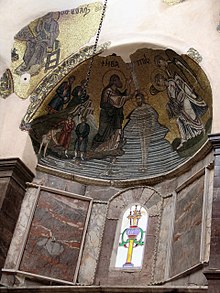
The rulings of the Council of Hieria were reversed by a new church council in 843, celebrated to this day in the Eastern Orthodox Church building as the "Triumph of Orthodoxy." In 867, the installation of a new apse mosaic in Hagia Sophia depicting the Virgin and Kid was celebrated past the Patriarch Photios in a famous homily as a victory over the evils of iconoclasm. Later in the same year, the Emperor Basil I, called "the Macedonian," acceded to the throne; equally a result the following period of Byzantine art has sometimes been chosen the "Macedonian Renaissance", although the term is doubly problematic (information technology was neither "Macedonian", nor, strictly speaking, a "Renaissance").
In the 9th and 10th centuries, the Empire's military machine situation improved, and patronage of art and architecture increased. New churches were deputed, and the standard architectural form (the "cross-in-square") and decorative scheme of the Middle Byzantine church were standardised. Major surviving examples include Hosios Loukas in Boeotia, the Daphni Monastery near Athens and Nea Moni on Chios.
In that location was a revival of interest in the depiction of subjects from classical Greek mythology (as on the Veroli Catafalque) and in the use of a "classical" Hellenistic styles to draw religious, and particularly Onetime Testament, subjects (of which the Paris Psalter and the Joshua Curl are important examples).
The Macedonian period as well saw a revival of the late antique technique of ivory carving. Many ornate ivory triptychs and diptychs survive, such as the Harbaville Triptych and a triptych at Luton Hoo, dating from the reign of Nicephorus Phocas.
Komnenian age [edit]

The Macedonian emperors were followed past the Komnenian dynasty, showtime with the reign of Alexios I Komnenos in 1081. Byzantium had recently suffered a period of severe dislocation following the Battle of Manzikert in 1071 and the subsequent loss of Asia Small-scale to the Turks. However, the Komnenoi brought stability to the empire (1081–1185) and during the course of the twelfth century their energetic campaigning did much to restore the fortunes of the empire. The Komnenoi were great patrons of the arts, and with their support Byzantine artists continued to motion in the management of greater humanism and emotion, of which the Theotokos of Vladimir, the cycle of mosaics at Daphni, and the murals at Nerezi yield important examples. Ivory sculpture and other expensive mediums of art gradually gave manner to frescoes and icons, which for the start fourth dimension gained widespread popularity across the Empire. Autonomously from painted icons, there were other varieties - notably the mosaic and ceramic ones.
Some of the finest Byzantine work of this catamenia may exist found outside the Empire: in the mosaics of Gelati, Kiev, Torcello, Venice, Monreale, Cefalù and Palermo. For example, Venice'south Basilica of St Marking, begun in 1063, was based on the great Church of the Holy Apostles in Constantinople, at present destroyed, and is thus an echo of the age of Justinian. The acquisitive habits of the Venetians hateful that the basilica is besides a neat museum of Byzantine artworks of all kinds (eastward.yard., Pala d'Oro).
Ivory caskets of the Macedonian era (Gallery) [edit]
-

-

11th-twelfth century, Museo Nazionale d'Arte Medievale e Moderna (Arezzo)
Palaeologan age [edit]

The Annunciation from Ohrid, one of the most admired icons of the Paleologan mannerism, bears comparison with the finest contemporary works by Italian artists
Centuries of continuous Roman political tradition and Hellenistic civilization underwent a crunch in 1204 with the sacking of Constantinople by the Venetian and French knights of the Fourth Crusade, a disaster from which the Empire recovered in 1261 albeit in a severely weakened state. The destruction by sack or subsequent neglect of the city'south secular compages in particular has left us with an imperfect agreement of Byzantine art.
Although the Byzantines regained the urban center in 1261, the Empire was thereafter a small and weak land bars to the Greek peninsula and the islands of the Aegean. During their half-century of exile, however, the last great flowing of Anatolian Hellenism began. As Nicaea emerged every bit the center of opposition under the Laskaris emperors, it spawned a renaissance, attracting scholars, poets, and artists from across the Byzantine globe. A glittering court emerged as the dispossessed intelligentsia establish in the Hellenic side of their traditions a pride and identity unsullied by association with the hated "latin" enemy.[61] With the recapture of the capital under the new Palaeologan Dynasty, Byzantine artists adult a new interest in landscapes and pastoral scenes, and the traditional mosaic-work (of which the Chora Church in Constantinople is the finest extant example) gradually gave way to detailed cycles of narrative frescoes (as evidenced in a big grouping of Mystras churches). The icons, which became a favoured medium for artistic expression, were characterized by a less austere attitude, new appreciation for purely decorative qualities of painting and meticulous attention to details, earning the popular proper noun of the Paleologan Mannerism for the menstruum in full general.
Venice came to control Byzantine Crete by 1212, and Byzantine artistic traditions continued long after the Ottoman conquest of the last Byzantine successor land in 1461. The Cretan school, every bit it is today known, gradually introduced Western elements into its style, and exported large numbers of icons to the West. The tradition's near famous artist was El Greco.[62] [63]
Legacy [edit]


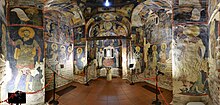
The splendour of Byzantine art was e'er in the mind of early medieval Western artists and patrons, and many of the most important movements in the period were witting attempts to produce art fit to stand next to both classical Roman and contemporary Byzantine fine art. This was particularly the example for the imperial Carolingian fine art and Ottonian art. Luxury products from the Empire were highly valued, and reached for case the majestic Anglo-Saxon Sutton Hoo burial in Suffolk of the 620s, which contains several pieces of argent. Byzantine silks were especially valued and large quantities were distributed as diplomatic gifts from Constantinople. There are records of Byzantine artists working in the West, especially during the menses of iconoclasm, and some works, like the frescos at Castelseprio and miniatures in the Vienna Coronation Gospels, seem to have been produced by such figures.
In particular, teams of mosaic artists were dispatched as diplomatic gestures by emperors to Italian republic, where they often trained locals to go on their work in a way heavily influenced past Byzantium. Venice and Norman Sicily were particular centres of Byzantine influence. The primeval surviving panel paintings in the Westward were in a style heavily influenced by contemporary Byzantine icons, until a distinctive Western fashion began to develop in Italy in the Trecento; the traditional and still influential narrative of Vasari and others has the story of Western painting begin equally a breakaway by Cimabue and then Giotto from the shackles of the Byzantine tradition. In full general, Byzantine creative influence on Europe was in steep decline by the 14th century if non earlier, despite the continued importance of migrated Byzantine scholars in the Renaissance in other areas.
Islamic art began with artists and craftsmen mostly trained in Byzantine styles, and though figurative content was greatly reduced, Byzantine decorative styles remained a dandy influence on Islamic fine art, and Byzantine artists continued to be imported for important works for some time, particularly for mosaics.
The Byzantine era properly defined came to an stop with the fall of Constantinople to the Ottoman Turks in 1453, only by this fourth dimension the Byzantine cultural heritage had been widely diffused, carried past the spread of Orthodox Christianity, to Bulgaria, Serbia, Romania and, about importantly, to Russia, which became the middle of the Orthodox world following the Ottoman conquest of the Balkans. Even under Ottoman dominion, Byzantine traditions in icon-painting and other small-calibration arts survived, specially in the Venetian-ruled Crete and Rhodes, where a "post-Byzantine" style under increasing Western influence survived for a further ii centuries, producing artists including El Greco whose grooming was in the Cretan Schoolhouse which was the most vigorous post-Byzantine school, exporting neat numbers of icons to Europe. The willingness of the Cretan School to accept Western influence was atypical; in most of the post-Byzantine world "as an instrument of indigenous cohesiveness, fine art became assertively conservative during the Turcocratia" (period of Ottoman rule).[64]
Russian icon painting began by entirely adopting and imitating Byzantine art, as did the fine art of other Orthodox nations, and has remained extremely conservative in iconography, although its painting style has developed distinct characteristics, including influences from post-Renaissance Western art. All the Eastern Orthodox churches have remained highly protective of their traditions in terms of the form and content of images and, for case, mod Orthodox depictions of the Birth of Christ vary little in content from those adult in the 6th century.
See also [edit]
- Byzantine illuminated manuscripts
- Byzantine architecture
- Byzantine mosaics
- Macedonian art (Byzantine)
- Byzantine Iconoclasm
- Sacred fine art
- Volume of Job in Byzantine Illuminated Manuscripts
Notes [edit]
- ^ Michelis 1946; Weitzmann 1981.
- ^ Kitzinger 1977, pp. 1‒3.
- ^ Michelis 1946; Ainalov 1961, "Introduction", pp. 3‒8; Stylianou & Stylianou 1985, p. 19; Hanfmann 1962, "Early Christian Sculpture", p. 42 harvnb error: no target: CITEREFHanfmann1962 (help); Weitzmann 1984.
- ^ Bassett 2004.
- ^ Cyril 1965, pp. 53‒75 harvnb error: no target: CITEREFCyril1965 (help).
- ^ Ainalov 1961, "The Hellenistic Character of Byzantine Wall Painting", pp. 185‒214.
- ^ Weitzmann 1981, p. 350.
- ^ Brendel 1979.
- ^ Berenson 1954.
- ^ Elsner 2002, pp. 358‒379.
- ^ Kitzinger 1977.
- ^ Onians 1980, pp. 1‒23.
- ^ Mango 1963, p. 65.
- ^ Belting & Jephcott 1994 harvnb error: no target: CITEREFBeltingJephcott1994 (help).
- ^ Bassett 2004.
- ^ Fowden 1991, pp. 119‒131; Bauer 1996.
- ^ Mathews 1971; Henck 2001, pp. 279‒304
- ^ Kiilerich 1998.
- ^ Mathews 1971.
- ^ Krautheimer 2000.
- ^ Spieser 1984; Ćurčić 2000.
- ^ Wright 1993.
- ^ Wright 2001.
- ^ Levin 1985.
- ^ Volbach 1976.
- ^ Delbrueck 1929.
- ^ Dodd 1961.
- ^ Almagro-Gorbea 2000.
- ^ Maas 2005.
- ^ Tr. H.B. Dewing, Procopius Vii (Cambridge, 1962).
- ^ Mainstone 1997.
- ^ Night & Özgümüş 2002, pp. 393‒413.
- ^ Bardill 2000, pp. 1‒eleven; Mathews 2005.
- ^ Forsyth & Weitzmann 1973.
- ^ Thiel 2005.
- ^ Deichmann 1969.
- ^ Eufrasiana Basilica Project.
- ^ Wellesz 1960.
- ^ Cavallo 1992.
- ^ Grabar 1948.
- ^ Mazal 1998.
- ^ Cutler 1993, pp. 329‒339.
- ^ Wright 1986, pp. 75‒79.
- ^ photo of the plate
- ^ Haldon 1997.
- ^ Brubaker 2004, pp. 63‒90.
- ^ Barber 1991, pp. 43‒threescore.
- ^ Matthiae 1987.
- ^ Creswell 1969; Flood 2001.
- ^ Leader 2000, pp. 407‒427.
- ^ Leroy 1964.
- ^ Nordenfalk 1938.
- ^ Brubaker 1998, pp. 1215‒1254.
- ^ Bryer & Herrin 1977; Brubaker & Haldon 2001.
- ^ Stein 1980; The story of the Chalke Icon may be a later on invention: Auzépy 1990, pp. 445‒492.
- ^ Grabar 1984.
- ^ Wright 1985, pp. 355‒362.
- ^ Bryer & Herrin 1977, Robin Cormack, "The Arts during the Age of Iconoclasm".
- ^ Peschlow 1977.
- ^ Theocharidou 1988.
- ^ Ash 1995.
- ^ Byron, Robert (Oct 1929). "Greco: The Epilogue to Byzantine Culture". The Burlington Magazine for Connoisseurs. 55 (319): 160–174. JSTOR 864104.
- ^ Procopiou, Angelo 1000. (March 1952). "El Greco and Cretan Painting". The Burlington Mag. 94 (588): 76–74. JSTOR 870678.
- ^ Kessler 1988, p. 166.
References [edit]
- Ainalov, D.V. (1961). The Hellenistic Origins of Byzantine Art. New Brunswick: Rutgers Academy Press.
- Almagro-Gorbea, Chiliad., ed. (2000). El Disco de Teodosio. Madrid: Existent Academia de la Historia. ISBN9788489512603.
- Ash, John (1995). A Byzantine Journey . London: Random Business firm Incorporated. ISBN9780679409342.
- Auzépy, M.-F. (1990). "La devastation de fifty'icône du Christ de la Chalcé par Léon Iii: propagande ou réalité?". Byzantion. threescore: 445‒492.
- Barber, C. (1991). "The Koimesis Church, Nicaea: The Limits of Representation on the Eve of Iconoclasm". Jahrbuch der österreichischen Byzantinistik. 41: 43‒sixty.
- Bardill, J. (2000). "The Church building of Sts. Sergius and Bacchus in Constantinople and the Monophysite Refugees". Dumbarton Oaks Papers. 54: i‒11. doi:10.2307/1291830. JSTOR 1291830.
- Bassett, Sarah (2004). The Urban Image of Late Antique Constantinople. Cambridge: Cambridge Academy Press. ISBN9780521827232.
- Bauer, Franz Alto (1996). Stadt, Platz und Denkmal in der Spätantike. Mainz: P. von Zabern. ISBN9783805318426.
- Belting, Hans; Jephcott (tr.), Edmund (1994). Likeness and Presence: A History of the Image before the Era of Art. Chicago: Chicago Academy Press. ISBN9780226042152.
- Berenson, Bernard (1954). The Arch of Constantine, or, the Turn down of Form. London: Chapman and Hall.
- Brendel, Otto J. (1979). Prolegomena to the Written report of Roman Fine art . New Haven: Yale Academy Press. ISBN9780300022681.
- Brubaker, Leslie; Haldon, John (2001). Byzantium in the Iconoclast Era (ca. 680-850): The Sources. Birmingham: Ashgate.
- Brubaker, L. (1998). "Icons before iconoclasm?, Morfologie sociali east culturali in europa fra tarda antichita e alto medioevo". Settimane di Studio del Centro Italiano di Studi Sull' Alto Medioevo. 45: 1215‒1254.
- Brubaker, 50. (2004). "Elites and Patronage in Early Byzantium: The Evidence from Hagios Demetrios in Thessalonike". In Haldon, John; et al. (eds.). The Byzantine and Early Islamic Virtually East: Elites Old and New. Princeton: Princeton Academy Press. pp. 63‒90.
- Bryer, A.; Herrin, Judith, eds. (1977). Iconoclasm: Papers Given at the Ninth Spring Symposium of Byzantine Studies, Academy of Birmingham, March 1975. Birmingham: Center for Byzantine Studies. ISBN9780704402263.
- Cavallo, Guglielmo (1992). Il codex purpureus rossanensis. Rome.
- Creswell, Keppel A.C. (1969). Early Muslim Compages. New York: Clarendon Printing.
- Ćurčić, Slobodan (2000). Some Observations and Questions Regarding Early on Christian Compages in Thessaloniki. Thessaloniki: Υπουργείον Πολιτισμού: Εφορεία Βυζαντινών Αρχαιοτήτων Θεσσαλονίκης. ISBN9789608674905.
- Cutler, A. (1993). "Barberiniana: Notes on the Making, Content, and Provenance of Louvre OA. 9063". Tesserae: Festschrift für Josef Engemann, Jahrbuch für Antike und Christentum, Ergänzungsband. eighteen: 329‒339.
- Nighttime, Thou.; Özgümüş, F. (2002). "New Prove for the Byzantine Church of the Holy Apostles from Fatih Camii, Istanbul". Oxford Journal of Archaeology. 21 (4): 393‒413. doi:10.1111/1468-0092.00170.
- Deichmann, Friedrich Wilhelm (1969). Ravenna: Hauptstadt des spätantiken Abendlandes. Wiesbaden: Franz Steiner. ISBN9783515020053.
- Delbrueck, R. (1929). Die Consulardiptychen und Verwandte Denkmäler. Berlin: De Gruyter.
- Dodd, Erica Cruikshank (1961). Byzantine Silverish Stamps. Washington: Dumbarton Oaks Inquiry Library and Collection, Trustees for Harvard Academy.
- Elsner, J. (2002). "The Birth of Late Antiquity: Riegl and Strzygowski in 1901". Art History. 25 (iii): 358‒379. doi:x.1111/1467-8365.00326.
- Ene D-Vasilescu, Elena (2021). Michelangelo, the Byzantines, and Plato. ISBN9781800498792.
- Ene D-Vasilescu, Elena (2021). Glimpses into Byzantium. Its Philosophy and Arts. ISBN9781800498808.
- Inundation, Finbarr Barry (2001). The Great Mosque of Damascus: Studies on the Making of an Umayyad Visual Culture. Leiden: Brill.
- Forsyth, George H.; Weitzmann, Kurt (1973). The Monastery of St. Catherine at Mountain Sinai: The Church and Fortress of Justinian. Ann Arbor: University of Michigan Press.
- Fowden, Garth (1991). "Constantine's Porphyry Column: The Earliest Literary Allusion". Journal of Roman Studies. 81: 119‒131. doi:ten.2307/300493. JSTOR 300493.
- Grabar, André (1984). L'iconoclasme byzantin: Le dossier archéologique (2nd ed.). Paris: Flammarion. ISBN9782080126030.
- Grabar, André (1948). Les peintures de l'évangéliaire de Sinope (Bibliothèque nationale, Suppl. gr. 1286). Paris: Bibliothèque nationale.
- Haldon, John (1997) [1990]. Byzantium in the Seventh Century: The Transformation of a Culture. Cambridge: Cambridge University Printing.
- Hanfmann, George Maxim Anossov (1967). Classical Sculpture. Greenwich, CT: New York Graphic Guild.
- Henck, N. (2001). "Constantius ho Philoktistes?" (PDF). Dumbarton Oaks Papers. 55: 279‒304. doi:10.2307/1291822. JSTOR 1291822. Archived from the original (PDF) on 2014-05-12. Retrieved 2014-09-29 .
- Kessler, Herbert 50. (1988). "On the State of Medieval Art History". The Art Bulletin. 70 (2): 166–187. doi:10.1080/00043079.1988.10788561. JSTOR 3051115.
- Kiilerich, Bente (1998). The Obelisk Base in Constantinople. Rome: G. Bretschneider.
- Kitzinger, Ernst (1977). Byzantine Fine art in the Making: Main Lines of Stylistic Evolution in Mediterranean Fine art, 3rd‒7th Century. Cambridge: Cambridge University Press. ISBN978-0571111541.
- Krautheimer, R. (2000). Rome: Contour of a City. Princeton: Princeton University Press. ISBN9780691049618.
- Leader, R. (2000). "The David Plates Revisited: Transforming the Secular in Early Byzantium". Fine art Bulletin. 82 (3): 407‒427. doi:10.2307/3051395. JSTOR 3051395.
- Leroy, Jules (1964). Les manuscrits syriaques à peintures conservés dans les bibliothèques d'Europe et d'Orient; contribution à l'étude de 50'iconographie des Églises de langue syriaque. Paris: Librairie orientaliste P. Geuthner.
- Levin, I. (1985). The Quedlinburg Itala: The Oldest Illustrated Biblical Manuscript. Leiden: East.J. Brill. ISBN9789004070936.
- Maas, M., ed. (2005). The Cambridge Companion to the Age of Justinian. Cambridge: Cambridge University Press. ISBN9781139826877.
- Mainstone, Rowland J. (1997). Hagia Sophia: Architecture, Structure, and Liturgy of Justinian'southward Great Church building. New York: Thames and Hudson. ISBN9780500279458.
- Mango, Cyril (1963). "Antique Statuary and the Byzantine Beholder". Dumbarton Oaks Papers. 17: 53‒75. doi:10.2307/1291190. JSTOR 1291190.
- Mathews, Thomas F. (1971). The Early Churches of Constantinople: Architecture and Liturgy. Academy Park: Pennsylvania Country University Press. ISBN9780271001081.
- Mathews, Thomas F. (2005). "The Palace Church of Sts. Sergius and Bacchus in Constantinople". In Emerick, J.J.; Delliyannis, D.1000. (eds.). Archaeology in Compages: Studies in Honour of Cecil 50. Striker. Mainz: von Zabern. ISBN9783805334921.
- Matthiae, Guglielmo (1987). Pittura romana del medioevo. Rome: Fratelli Palombi. ISBN9788876212345.
- Mazal, Otto (1998). Der Wiener Dioskurides: Codex medicus Graecus i der Österreichischen Nationalbibliothek. Graz: Akademische Druck u. Verlagsanstalt. ISBN9783201016995.
- Michelis, Panayotis A. (1946). An Aesthetic Arroyo to Byzantine Art. Athens.
- Nordenfalk, Carl (1938). Die spätantiken Kanontafeln. Göteborg: O. Isacsons boktryckeri a.-b.
- Onians, J. (1980). "Abstraction and Imagination in Belatedly Antiquity". Fine art History. 3: 1‒23. doi:10.1111/j.1467-8365.1980.tb00061.x.
- Peschlow, Urs (1977). Die Irenenkirche in Istanbul. Tübingen: Due east. Wasmuth. ISBN9783803017178.
- Runciman, Steven (1987) [1954]. A History of the Crusades: The Kingdom of Acre and the Later on Crusades. Cambridge: Cambridge University Press. ISBN978-0521347723.
- Spieser, J.-One thousand. (1984). Thessalonique et ses monuments du IVe au VIe siècle. Athens: Ecole française d'Athènes.
- Stein, D. (1980). Der Beginn des byzantinischen Bilderstreites und seine Entwicklung bis in dice 40er Jahre des 8. Jahrhunderts. Munich: Institut für Byzantinistik und Neugriechische Philologie der Universität.
- Stylianou, Andreas; Stylianou, Judith A. (1985). The Painted Churches of Cyprus: Treasures of Byzantine Art. London: Trigraph for the A.G. Leventis Foundation.
- Theocharidou, K. (1988). The Architecture of Hagia Sophia, Thessaloniki, from its Erection up to the Turkish Conquest. Oxford: Oxford University Printing.
- Thiel, Andreas (2005). Die Johanneskirche in Ephesos. Wiesbaden: Isd. ISBN9783895003547.
- Volbach, Wolfgang Fritz (1976). Elfenbeinarbeiten der Spätantike und des frühen Mittelalters. Mainz: von Zabern. ISBN9783805302807.
- Weitzmann, Kurt (1981). Classical Heritage in Byzantine and Well-nigh Eastern Art. London: Variorum Reprints.
- Weitzmann, Kurt (1984). Greek Mythology in Byzantine Art. Princeton: Princeton University Press. ISBN9780860780878.
- Wellesz, Emmy (1960). The Vienna Genesis. London: T. Yoseloff.
- Wright, D. H. (1985). "The Date of the Vatican Illuminated Handy Tables of Ptolemy and of its Early Additions". Byzantinische Zeitschrift. 78 (2): 355‒362. doi:10.1515/byzs.1985.78.2.355. S2CID 194111177.
- Wright, D. (1986). "Justinian and an Archangel". Studien zur Spätantiken Kunst Friedrich Wilhelm Deichmann Gewidmet. Mainz. 3: 75‒79.
- Wright, David Herndon (2001). The Roman Vergil and the Origins of Medieval Volume Pattern. Toronto: University of Toronto Printing. ISBN9780802048196.
- Wright, David Herndon (1993). The Vatican Vergil: A Masterpiece of Late Antiquarian Art. Berkeley: University of California Press. ISBN9780520072404.
Farther reading [edit]
- Alloa, Emmanuel (2013). "Visual Studies in Byzantium". Periodical of Visual Civilisation. 12 (1): iii‒29. doi:x.1177/1470412912468704. S2CID 191395643.
- Beckwith, John (1979). Early on Christian and Byzantine Art (2nd ed.). Penguin History of Art. ISBN978-0140560336.
- Cormack, Robin (2000). Byzantine Art . Oxford: Oxford Academy Press. ISBN978-0-19-284211-4.
- Cormack, Robin (1985). Writing in Gold, Byzantine Lodge and its Icons. London: George Philip. ISBN978-054001085-one.
- Eastmond, Antony (2013). The Celebrity of Byzantium and Early Christendom. London: Phaidon Press. ISBN978-0714848105.
- Evans, Helen C., ed. (2004). Byzantium, Faith and Power (1261‒1557) . Metropolitan Museum of Art/Yale University Press. ISBN978-1588391148.
- Evans, Helen C. & Wixom, William D. (1997). The Glory of Byzantium: Art and Culture of the Middle Byzantine Era, A.D. 843‒1261. New York: The Metropolitan Museum of Art. OCLC 853250638.
- Hurst, Ellen (eight August 2014). "A Beginner's Guide to Byzantine Art". Smarthistory. Retrieved 20 April 2016.
- James, Elizabeth (2007). Fine art and Text in Byzantine Culture (ane ed.). Cambridge: Cambridge Academy Press. ISBN978-0-521-83409-4.
- Karahan, Anne (2015). "Patristics and Byzantine Meta-Images. Molding Belief in the Divine from Written to Painted Theology". In Harrison, Carol; Bitton-Ashkelony, Brouria; De Bruyn, Théodore (eds.). Patristic Studies in the Xx-First Century. Turnhout: Brepols Publishers. pp. 551–576. ISBN978-2-503-55919-3.
- Karahan, Anne (2010). Byzantine Holy Images – Transcendence and Immanence. The Theological Groundwork of the Iconography and Aesthetics of the Chora Church (Orientalia Lovaniensia Analecta No. 176). Leuven-Paris-Walpole, MA: Peeters Publishers. ISBN978-90-429-2080-4.
- Karahan, Anne (2016). "Byzantine Visual Civilization. Weather of "Right" Belief and some Platonic Outlooks"". Numen: International Review for the History of Religions. Leiden: Koninklijke Brill NV. 63 (2–three): 210–244. doi:10.1163/15685276-12341421. ISSN 0029-5973.
- Karahan, Anne (2014). "Byzantine Iconoclasm: Ideology and Quest for Power". In Kolrud, One thousand.; Prusac, Thousand. (eds.). Iconoclasm from Antiquity to Modernity. Farnham Surrey: Ashgate Publishing Ltd. pp. 75‒94. ISBN978-1-4094-7033-5.
- Karahan, Anne (2015). "Chapter 10: The Affect of Cappadocian Theology on Byzantine Aesthetics: Gregory of Nazianzus on the Unity and Singularity of Christ". In Dumitraşcu, Due north. (ed.). The Ecumenical Legacy of the Cappadocians. New York, NY: Palgrave Macmillan. pp. 159‒184. ISBN978-1-137-51394-6.
- Karahan, Anne (2012). "Dazzler in the Eyes of God. Byzantine Aesthetics and Basil of Caesarea". Byzantion: Revue Internationale des Études Byzantines. 82: 165‒212. eISSN 2294-6209. ISSN 0378-2506. *Karahan, Anne (2013). "The Image of God in Byzantine Cappadocia and the Issue of Supreme Transcendence". Studia Patristica. 59: 97‒111. ISBN978-90-429-2992-0.
- Karahan, Anne (2010). "The Issue of περιχώρησις in Byzantine Holy Images". Studia Patristica. 44: 27‒34. ISBN978-90-429-2370-half-dozen.
- Gerstel, Sharon E. J.; Lauffenburger, Julie A., eds. (2001). A Lost Fine art Rediscovered. Pennsylvania Country University. ISBN978-0-271-02139-three.
- Mango, Cyril, ed. (1972). The Fine art of the Byzantine Empire, 312‒1453: Sources and Documents. Englewood Cliffs.
- Obolensky, Dimitri (1974) [1971]. The Byzantine Republic: Eastern Europe, 500‒1453. London: Central. ISBN9780351176449.
- http://www.biblionet.gr/volume/178713/Ανδρέου,_Ευάγγελος/Γεώργιος_Μάρκου_ο_ΑργείοςWeitzmann, Kurt, ed. (1979). Age of Spirituality: Late Antiquarian and Early Christian Art, 3rd to Seventh Century. New York: The Metropolitan Museum of Fine art.
External links [edit]
- Byzantine Publications Online, freely bachelor for download from Dumbarton Oaks
- Lethaby, William (1911). . Encyclopædia Britannica. Vol. 4 (11th ed.). pp. 906–911.
- Eikonografos.com: Byzantine Icons and Mosaics Archived 2012-03-31 at the Wayback Motorcar
- Anthony Cutler on the economic history of Byzantine mosaics, wall-paintings and icons at Dumbarton Oaks.
- http://www.biblionet.gr/book/178713/Ανδρέου,_Ευάγγελος/Γεώργιος_Μάρκου_ο_Αργείος
Source: https://en.wikipedia.org/wiki/Byzantine_art

Post a Comment for "Other Than Constantinople Where Can Byzantine Art Be Seen"