the closeness of a measurement to the actual value of what is being measured
Accurateness and precision are two measures of observational error. Accuracy is how shut or far off a given fix of measurements (observations or readings) are to their truthful value, while precision is how close or dispersed the measurements are to each other.
In other words, precision is a clarification of random errors, a measure of statistical variability. Accuracy has two definitions:
- More commonly, it is a clarification of just systematic errors, a mensurate of statistical bias of a given measure of fundamental tendency; low accurateness causes a departure between a issue and a true value; ISO calls this trueness .
- Alternatively, ISO defines[i] accurateness every bit describing a combination of both types of observational error (random and systematic), so loftier accurateness requires both loftier precision and loftier trueness.
In the commencement, more mutual definition of "accuracy" above, the concept is independent of "precision", then a detail prepare of data can exist said to be accurate, precise, both, or neither.
In simpler terms, given a statistical sample or ready of data points from repeated measurements of the same quantity, the sample or set up can be said to exist accurate if their average is close to the true value of the quantity beingness measured, while the set can be said to exist precise if their standard deviation is relatively small-scale.
Mutual technical definition [edit]

Accuracy is the proximity of measurement results to the true value; precision is the degree to which repeated (or reproducible) measurements under unchanged conditions evidence the aforementioned results.
In the fields of science and applied science, the accuracy of a measurement system is the caste of closeness of measurements of a quantity to that quantity'south true value.[2] The precision of a measurement system, related to reproducibility and repeatability, is the degree to which repeated measurements under unchanged conditions bear witness the same results.[ii] [3] Although the two words precision and accuracy can be synonymous in colloquial use, they are deliberately assorted in the context of the scientific method.
The field of statistics, where the interpretation of measurements plays a primal role, prefers to use the terms bias and variability instead of accuracy and precision: bias is the corporeality of inaccuracy and variability is the amount of imprecision.
A measurement organization tin be authentic but not precise, precise but non accurate, neither, or both. For example, if an experiment contains a systematic error, then increasing the sample size more often than not increases precision but does non improve accurateness. The upshot would be a consequent yet inaccurate string of results from the flawed experiment. Eliminating the systematic error improves accuracy but does not change precision.
A measurement system is considered valid if it is both accurate and precise. Related terms include bias (non-random or directed effects acquired by a factor or factors unrelated to the contained variable) and error (random variability).
The terminology is besides applied to indirect measurements—that is, values obtained by a computational procedure from observed information.
In improver to accuracy and precision, measurements may also have a measurement resolution, which is the smallest change in the underlying concrete quantity that produces a response in the measurement.
In numerical analysis, accurateness is also the nearness of a calculation to the true value; while precision is the resolution of the representation, typically defined past the number of decimal or binary digits.
In armed services terms, accuracy refers primarily to the accuracy of fire (justesse de tir), the precision of burn expressed past the closeness of a group of shots at and around the centre of the target.[iv]
Quantification [edit]
In industrial instrumentation, accuracy is the measurement tolerance, or transmission of the instrument and defines the limits of the errors made when the instrument is used in normal operating conditions.[5]
Ideally a measurement device is both accurate and precise, with measurements all close to and tightly amassed effectually the truthful value. The accuracy and precision of a measurement process is usually established by repeatedly measuring some traceable reference standard. Such standards are defined in the International Organization of Units (abbreviated SI from French: Système international d'unités) and maintained past national standards organizations such as the National Institute of Standards and Engineering in the U.s.a..
This also applies when measurements are repeated and averaged. In that case, the term standard error is properly practical: the precision of the average is equal to the known standard deviation of the procedure divided past the square root of the number of measurements averaged. Further, the cardinal limit theorem shows that the probability distribution of the averaged measurements will be closer to a normal distribution than that of individual measurements.
With regard to accuracy we can distinguish:
- the difference betwixt the mean of the measurements and the reference value, the bias. Establishing and correcting for bias is necessary for calibration.
- the combined event of that and precision.
A mutual convention in science and engineering is to express accuracy and/or precision implicitly by means of meaning figures. Where not explicitly stated, the margin of error is understood to be one-half the value of the last significant identify. For instance, a recording of 843.six m, or 843.0 1000, or 800.0 thou would imply a margin of 0.05 m (the last significant place is the tenths identify), while a recording of 843 m would imply a margin of fault of 0.5 m (the final significant digits are the units).
A reading of viii,000 m, with abaft zeros and no decimal point, is ambiguous; the trailing zeros may or may not be intended as pregnant figures. To avoid this ambivalence, the number could be represented in scientific annotation: 8.0 × 10³ m indicates that the first zero is significant (hence a margin of 50 g) while viii.000 × 103 m indicates that all 3 zeros are significant, giving a margin of 0.5 chiliad. Similarly, ane can use a multiple of the basic measurement unit: eight.0 km is equivalent to 8.0 × 10iii m. It indicates a margin of 0.05 km (50 thousand). However, reliance on this convention can lead to imitation precision errors when accepting data from sources that do not obey it. For case, a source reporting a number similar 153,753 with precision +/- v,000 looks like it has precision +/- 0.five. Under the convention it would have been rounded to 154,000.
Alternatively, in a scientific context, if it is desired to signal the margin of fault with more precision, one can use a notation such every bit 7.54398(23) × 10−x m, significant a range of between 7.54375 and vii.54421 × 10−10 g.
Precision includes:
- repeatability — the variation arising when all efforts are made to continue atmospheric condition abiding by using the aforementioned instrument and operator, and repeating during a brusque fourth dimension period; and
- reproducibility — the variation arising using the aforementioned measurement procedure amongst different instruments and operators, and over longer time periods.
In engineering, precision is often taken as three times Standard Deviation of measurements taken, representing the range that 99.73% of measurements can occur within.[6] For example, an ergonomist measuring the human trunk can be confident that 99.73% of their extracted measurements fall within ± 0.vii cm - if using the GRYPHON processing organization - or ± xiii cm - if using unprocessed data.[vii]
ISO definition (ISO 5725) [edit]
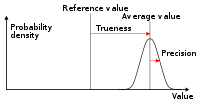
According to ISO 5725-1, Accuracy consists of trueness (proximity of measurement results to the true value) and precision (repeatability or reproducibility of the measurement)
A shift in the meaning of these terms appeared with the publication of the ISO 5725 serial of standards in 1994, which is also reflected in the 2008 issue of the "BIPM International Vocabulary of Metrology" (VIM), items ii.13 and two.fourteen.[ii]
According to ISO 5725-1,[one] the full general term "accuracy" is used to depict the closeness of a measurement to the true value. When the term is practical to sets of measurements of the same measurand, it involves a component of random fault and a component of systematic error. In this example trueness is the closeness of the mean of a set of measurement results to the actual (true) value and precision is the closeness of agreement among a prepare of results.
ISO 5725-ane and VIM likewise avoid the use of the term "bias", previously specified in BS 5497-ane,[viii] because information technology has different connotations outside the fields of science and engineering, as in medicine and constabulary.
-

Low accuracy due to low precision
-

Low accuracy even with high precision
In binary classification [edit]
Accuracy is besides used every bit a statistical measure of how well a binary nomenclature test correctly identifies or excludes a status. That is, the accuracy is the proportion of correct predictions (both true positives and true negatives) among the full number of cases examined.[9] As such, information technology compares estimates of pre- and post-test probability. To brand the context clear by the semantics, information technology is oft referred to as the "Rand accuracy" or "Rand index".[ten] [11] [12] Information technology is a parameter of the exam. The formula for quantifying binary accurateness is:

where TP = True positive; FP = False positive; TN = True negative; FN = Fake negative
Note that, in this context, the concepts of trueness and precision as defined by ISO 5725-i are not applicable. Ane reason is that there is not a unmarried "true value" of a quantity, but rather 2 possible true values for every case, while accuracy is an average across all cases and therefore takes into account both values. Nevertheless, the term precision is used in this context to mean a dissimilar metric originating from the field of data retrieval (see below).
In psychometrics and psychophysics [edit]
In psychometrics and psychophysics, the term accurateness is interchangeably used with validity and constant error. Precision is a synonym for reliability and variable fault. The validity of a measurement instrument or psychological test is established through experiment or correlation with behavior. Reliability is established with a variety of statistical techniques, classically through an internal consistency exam like Cronbach's alpha to ensure sets of related questions have related responses, and and so comparison of those related question between reference and target population.[ citation needed ]
In logic simulation [edit]
In logic simulation, a common mistake in evaluation of accurate models is to compare a logic simulation model to a transistor excursion simulation model. This is a comparison of differences in precision, non accuracy. Precision is measured with respect to detail and accuracy is measured with respect to reality.[xiii] [14]
In information systems [edit]
Data retrieval systems, such as databases and web search engines, are evaluated by many dissimilar metrics, some of which are derived from the confusion matrix, which divides results into truthful positives (documents correctly retrieved), true negatives (documents correctly not retrieved), imitation positives (documents incorrectly retrieved), and false negatives (documents incorrectly not retrieved). Commonly used metrics include the notions of precision and recall. In this context, precision is defined equally the fraction of retrieved documents which are relevant to the query (true positives divided by truthful+false positives), using a gear up of ground truth relevant results selected by humans. Recall is defined every bit the fraction of relevant documents retrieved compared to the total number of relevant documents (truthful positives divided past true positives+imitation negatives). Less unremarkably, the metric of accuracy is used, is defined as the total number of correct classifications (true positives plus true negatives) divided by the total number of documents.
None of these metrics take into account the ranking of results. Ranking is very important for spider web search engines because readers seldom become past the first page of results, and there are also many documents on the web to manually classify all of them every bit to whether they should be included or excluded from a given search. Adding a cutoff at a item number of results takes ranking into account to some degree. The measure precision at k, for example, is a mensurate of precision looking but at the peak ten (k=10) search results. More sophisticated metrics, such as discounted cumulative proceeds, have into business relationship each private ranking, and are more commonly used where this is important.
Run across also [edit]
- Bias-variance tradeoff in statistics and auto learning
- Accepted and experimental value
- Data quality
- Engineering tolerance
- Carefulness (disambiguation)
- Experimental uncertainty analysis
- F-score
- Hypothesis tests for accurateness
- Information quality
- Measurement uncertainty
- Precision (statistics)
- Probability
- Random and systematic errors
- Sensitivity and specificity
- Significant figures
- Statistical significance
References [edit]
- ^ a b BS ISO 5725-1: "Accurateness (trueness and precision) of measurement methods and results - Role 1: Full general principles and definitions.", p.1 (1994)
- ^ a b c JCGM 200:2008 International vocabulary of metrology — Basic and general concepts and associated terms (VIM)
- ^ Taylor, John Robert (1999). An Introduction to Error Analysis: The Study of Uncertainties in Physical Measurements. Academy Science Books. pp. 128–129. ISBN0-935702-75-X.
- ^ North Atlantic Treaty Organization, Nato Standardization Agency AAP-6 - Glossary of terms and definitions, p 43.
- ^ Creus, Antonio. Instrumentación Industrial [ citation needed ]
- ^ Blackness, J. Temple (21 July 2020). DeGarmo'due south materials and processes in manufacturing. ISBN978-one-119-72329-five. OCLC 1246529321.
- ^ Parker, Christopher J.; Gill, Simeon; Harwood, Adrian; Hayes, Steven G.; Ahmed, Maryam (2021-05-19). "A Method for Increasing 3D Body Scanning'due south Precision: Gryphon and Consecutive Scanning". Ergonomics. 65 (1): 39–59. doi:10.1080/00140139.2021.1931473. ISSN 0014-0139. PMID 34006206.
- ^ BS 5497-1: "Precision of test methods. Guide for the determination of repeatability and reproducibility for a standard test method." (1979)
- ^ Metz, CE (Oct 1978). "Basic principles of ROC analysis" (PDF). Semin Nucl Med. 8 (4): 283–98. doi:10.1016/s0001-2998(78)80014-2. PMID 112681.
- ^ "Archived copy" (PDF). Archived from the original (PDF) on 2015-03-11. Retrieved 2015-08-09 .
{{cite spider web}}: CS1 maint: archived re-create equally title (link) - ^ Powers, David M. Due west. (2015). "What the F-measure doesn't measure". arXiv:1503.06410 [cs.IR].
- ^ David M W Powers. "The Problem with Kappa" (PDF). Anthology.aclweb.org . Retrieved 11 December 2017.
- ^ Acken, John M. (1997). "none". Encyclopedia of Computer science and Engineering science. 36: 281–306.
- ^ Glasser, Mark; Mathews, Rob; Acken, John M. (June 1990). "1990 Workshop on Logic-Level Modelling for ASICS". SIGDA Newsletter. 20 (1).
External links [edit]
- BIPM - Guides in metrology, Guide to the Expression of Uncertainty in Measurement (GUM) and International Vocabulary of Metrology (VIM)
- "Beyond NIST Traceability: What really creates accuracy", Controlled Environments magazine
- Precision and Accuracy with Three Psychophysical Methods
- Appendix D.1: Terminology, Guidelines for Evaluating and Expressing the Uncertainty of NIST Measurement Results
- Accuracy and Precision
- Accuracy vs Precision — a brief video past Matt Parker
- What's the difference between accuracy and precision? by Matt Anticole at TED-Ed
- Precision and Accuracy examination written report guide
Source: https://en.wikipedia.org/wiki/Accuracy_and_precision#:~:text=According%20to%20ISO%205725%2D1%2C%20the%20general%20term%20%22accuracy,measurement%20to%20the%20true%20value.

Post a Comment for "the closeness of a measurement to the actual value of what is being measured"